
Test how the system changes
Use scenarios that remove a component, alter a condition, or interrupt a pathway so you must predict an outcome from the biological relationship.
A biology quiz should reveal whether you can explain a process, interpret evidence, and apply a relationship, not only identify familiar vocabulary. Import or paste one checked topic into BrainDen, preserve its diagrams and source context, and use practice questions to locate whether the real gap is terminology, sequence, regulation, comparison, or experimental reasoning.
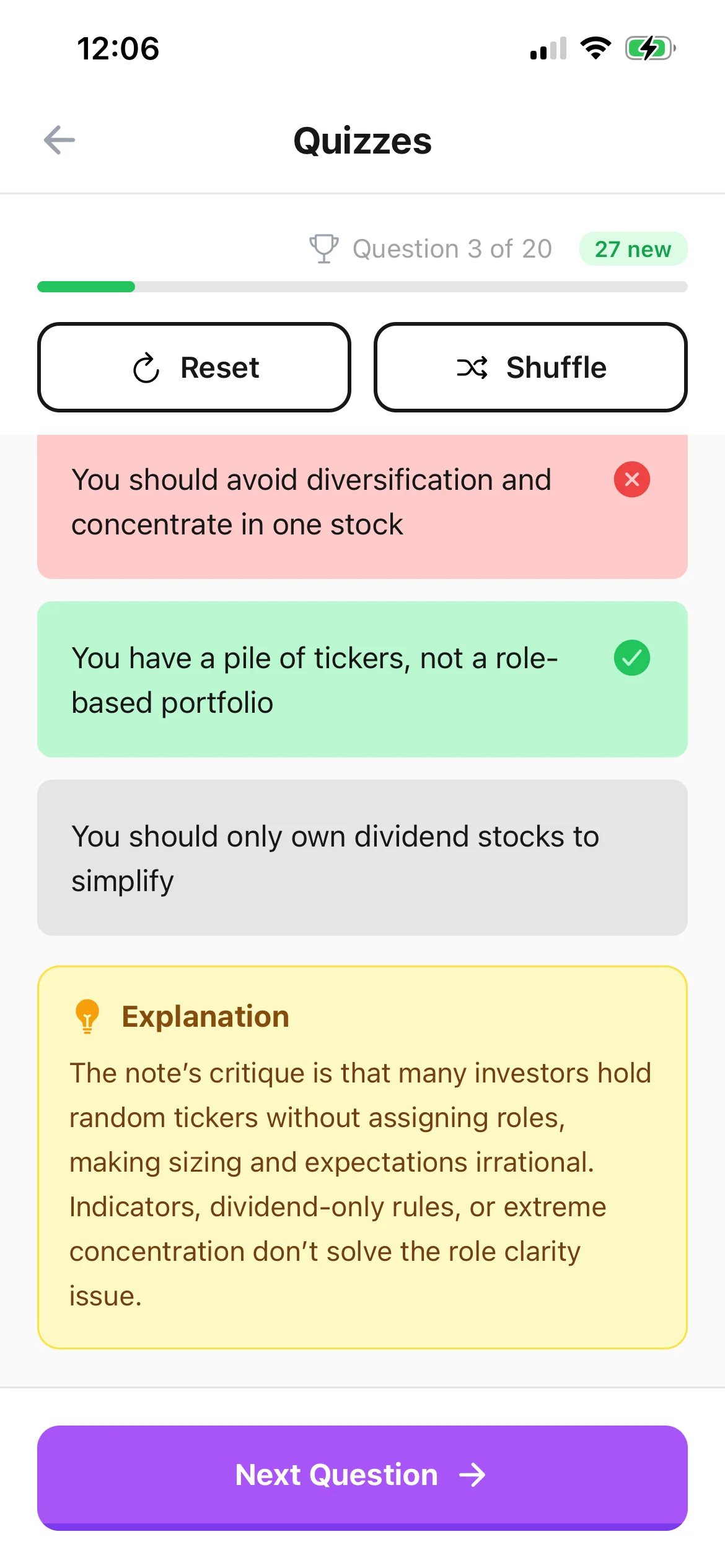
Use scenarios that remove a component, alter a condition, or interrupt a pathway so you must predict an outcome from the biological relationship.
Ask about controls, variables, measurements, result patterns, and supported conclusions when experiments are part of the learning objective.
Return to the full note for an explanation, the attached diagram for spatial detail, or the graph and method for evidence rather than rereading everything.
Workflow fit
From source to active study
Define the process, system, comparison, or experiment to test. Verify terminology, sequence, location, direction, conditions, and labels before opening the quiz.
Choose an answer before consulting the note, then explain the relationship or prediction that makes it correct instead of relying on which option looks familiar.
Decide whether the error involved a term, structure-function link, pathway step, experimental design, or application. Repair that part and try a related question later.
A concrete example
Checked notes comparing transcriptional and post-transcriptional control, regulatory proteins, RNA processing, environmental signals, and prokaryotic and eukaryotic examples.
A useful result could include
Generated material is a study aid. Review important terminology, notation, and claims against your source.
Make the result better
BrainDen removes repetitive setup work. Your judgement, course context, and retrieval practice are what turn the result into learning.
Name the component, location, relationship, and direction that make the answer work. Phrases such as “it affects the cell” hide the exact gap.
Generated text can omit spatial or quantitative detail. Verify axes, units, labels, pathway arrows, and anatomical relationships against the attached source.
After a definition question, try a new organism, cell type, condition, or experimental result that requires the same principle rather than the same wording.
Questions and answers
Yes. Paste or import a focused topic, verify the structured note against your course material, and use its connected quiz view for practice.
Keep diagrams, graphs, methods, and results attached to the source. Use questions to test their labels, relationships, design, and interpretation, then verify exact detail there.
Identify whether the gap was terminology, sequence, location, mechanism, evidence, or application, correct it from the source, explain it, and retest after a delay.
Begin with one coherent chapter, lecture, system, or learning objective. Smaller quizzes make each error easier to locate and repair.
Continue in your connected library
Folders tell you where a note belongs. Links show how its ideas relate to the rest of what you know. Connect a concept to another lecture, reading, or course and use backlinks to find the relationship from either side.
Explore this featureReview the whole topicExam topics rarely fit inside one note. Select the lectures, readings, and explanations that belong together, then review them in one continuous view without replacing or rewriting the originals.
Explore this featureKeep building your study system
Start with checked biology notes, diagrams, readings, and lab explanations, create a connected note, and choose the study tools that help you understand and remember it.