
Use your course scope
Build practice from the chapters, lectures, examples, and terminology your assessment uses instead of relying on an unrelated generic question bank.
A useful chemistry quiz should test the models, notation, calculations, and reasoning used in your course, not just produce random element trivia. Import or paste one focused topic into BrainDen, verify every equation and unit, and use the connected quiz to locate the exact concept or worked step that needs repair.
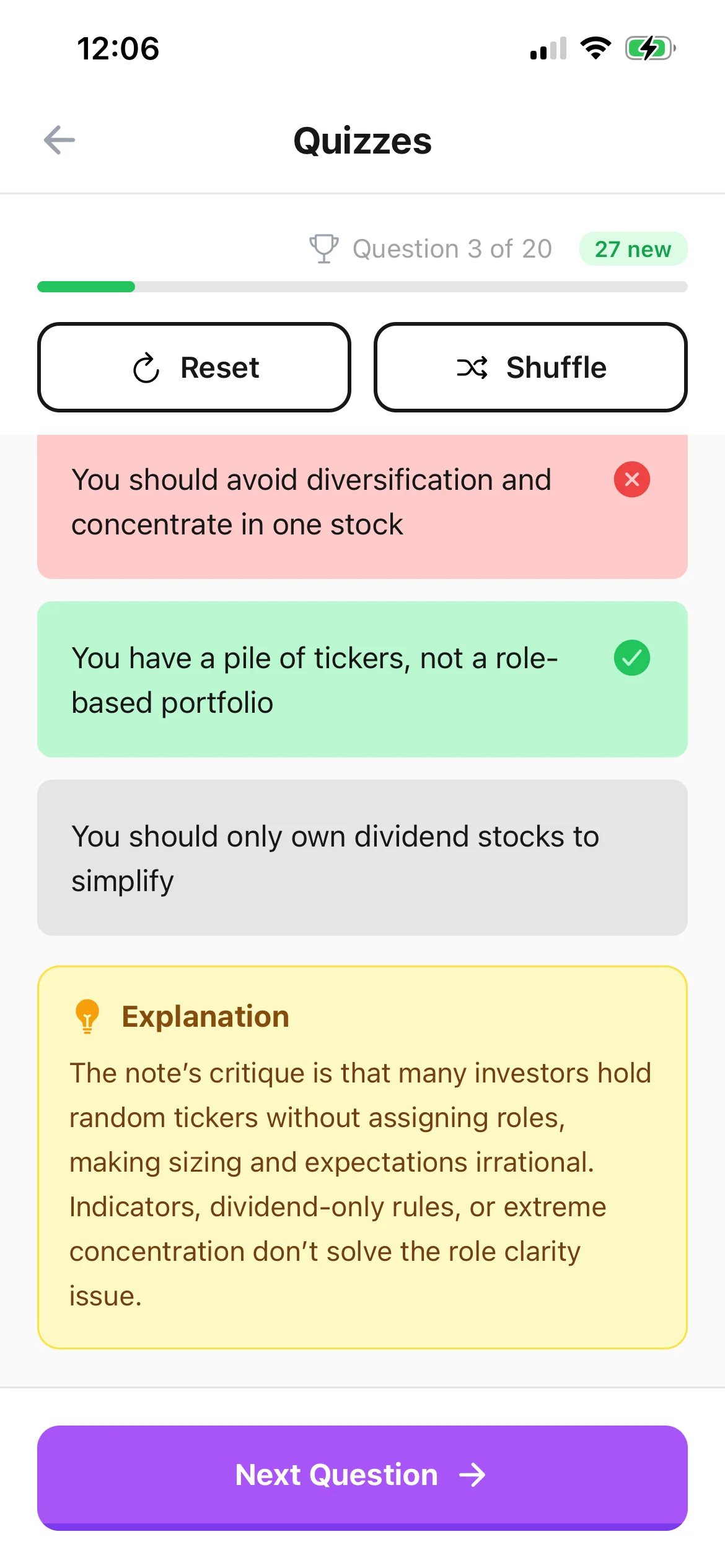
Build practice from the chapters, lectures, examples, and terminology your assessment uses instead of relying on an unrelated generic question bank.
Mix definitions with equation choices, unit conversions, particle explanations, graph interpretation, and short scenarios when the objective requires application.
Return from a missed answer to the checked note, source passage, diagram, or worked calculation that explains why the correct method works.
Workflow fit
From source to active study
Choose a chapter, lecture, or objective and verify formulas, balanced equations, charges, units, graph labels, and conditions before creating practice questions.
Commit to the concept, equation, setup, or calculation route first. Write units at every stage and explain why the chosen relationship applies.
Decide whether the gap was conceptual, algebraic, numerical, or notational, repair that step in the connected source, and try a related question after a delay.
A concrete example
A checked note containing balanced reactions, mole ratios, molar mass conversions, limiting reactants, theoretical yield, and three worked examples.
A useful result could include
Generated material is a study aid. Review important terminology, notation, and claims against your source.
Make the result better
BrainDen removes repetitive setup work. Your judgement, course context, and retrieval practice are what turn the result into learning.
A missing charge, coefficient, state symbol, exponent, or unit can change the question. Check exact notation against the source before memorizing a pattern.
Record the relationship, conversion factors, units, and assumptions used. A correct final value can hide a method that will fail on the next problem.
After learning one worked example, practise a question that changes the known quantity, asks for another target, or introduces an irrelevant value.
Questions and answers
Yes. Paste or import one focused topic, review the structured note, verify exact chemistry detail, and open its connected quiz view.
Use checked notes and worked examples as the starting point, then verify equations, units, setup, and numerical detail against your course source.
Start with one chapter, lecture, reaction family, or learning objective. Smaller sets make errors easier to diagnose and repair.
Identify whether the gap is conceptual, algebraic, numerical, or notational, check the exact source or worked step, explain the correction, and retest later.
Continue in your connected library
A growing study library should match the way your course is actually structured. Build folders inside folders so lectures, readings, assignments, and revision topics stay easy to find.
Explore this featureConnect related ideasFolders tell you where a note belongs. Links show how its ideas relate to the rest of what you know. Connect a concept to another lecture, reading, or course and use backlinks to find the relationship from either side.
Explore this featureKeep building your study system
Start with checked chemistry notes, worked examples, or a permitted chapter, create a connected note, and choose the study tools that help you understand and remember it.