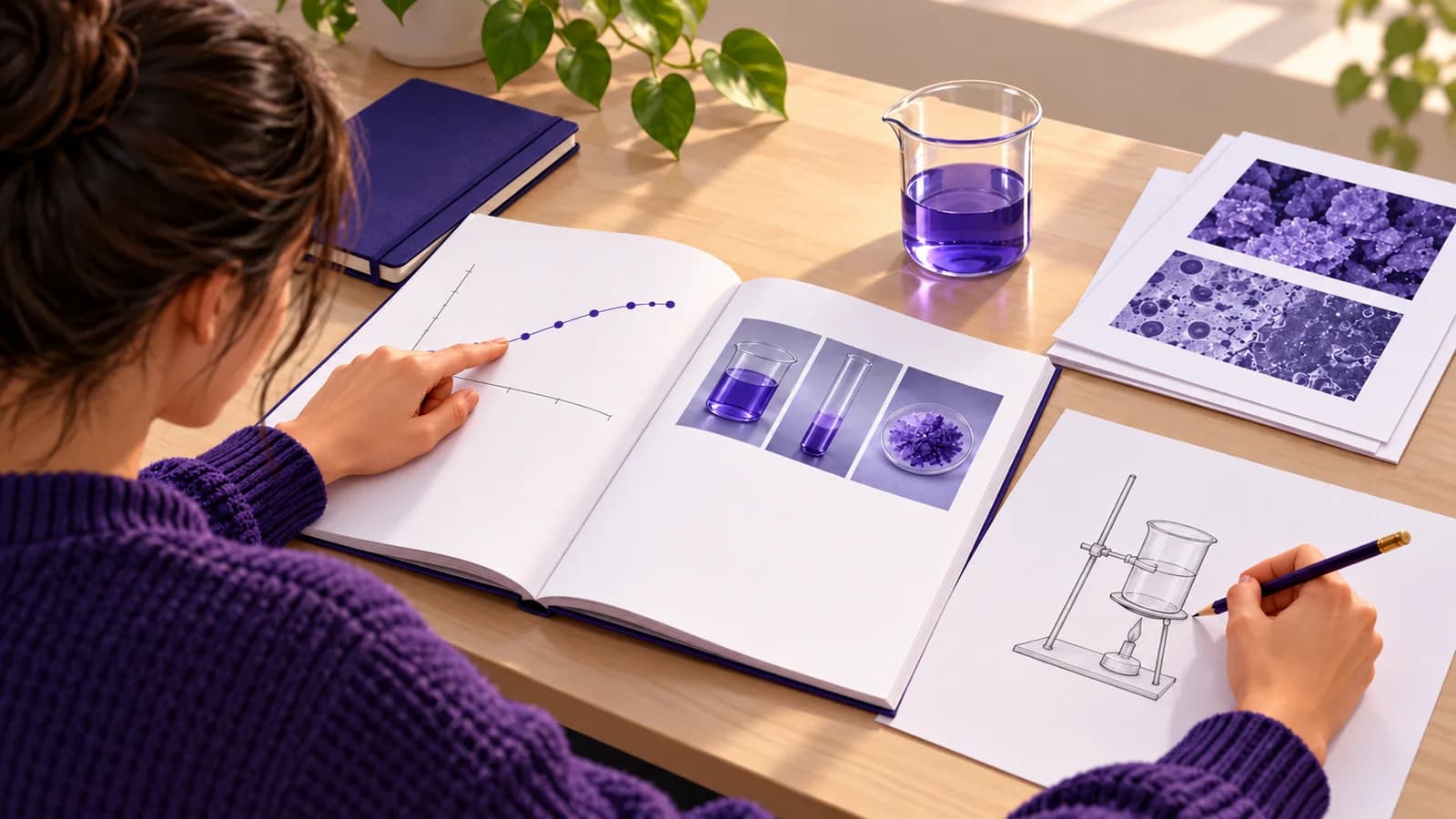
To study from lab reports for exams, treat each report as evidence of a scientific decision. Identify the question, explain why the method could answer it, interpret the results, and state what the results do not prove. Then close the report and apply the same reasoning to a new data set or experimental setup. Memorizing the report's wording is less useful when an exam changes the specimen, measurements, or conditions.
This guide starts with reports you have already completed. It shows how to turn them into short study notes and practice questions. It also covers exams that test procedures, calculations, or visual identification instead of a written explanation.
First check what your exam will ask you to do
A lab report records what you did, what you found, and what the results mean. UNSW Sydney's lab report guide uses those three questions to explain a report's purpose. An exam may ask for a different output. You might need to interpret an unfamiliar graph, select a control, justify a procedure, identify a specimen, or explain an error.
Find the exam description, learning objectives, past questions, and feedback from earlier work. Mark the verbs in those materials: identify, calculate, compare, justify, predict, or evaluate. Those verbs tell you what to practice. Do not assume that every detail in every report has equal value.
The University of Guelph's lab exam guidance recommends combining lab and course material. It also asks students to consider new experiments and unfamiliar specimens. Use that as a reason to test transfer. Your instructor's scope and format come first.
Make a two-column list before you open the reports:
| Exam task | Evidence to find in your reports |
|---|---|
| Explain a method | Why each critical step or control was needed |
| Interpret data | What the table or graph shows, including units |
| Evaluate a conclusion | Whether the evidence supports the claim |
| Apply a concept | How the outcome might change under a new condition |
| Perform a procedure | Ordered steps, equipment, and safety rules |
If the exam is a timed station test, add the type of image, specimen, or apparatus you will see. A written report alone cannot replace practice with the expected presentation format.
Turn each report into an experiment card
Do not copy the full report into a second document. Make one short card for each experiment. The card should preserve the reasoning chain and point back to the original report when you need a detail.
Use these fields:
- Question: What did the experiment try to find out?
- Prediction: What result did you expect, and why?
- Design: Which variable changed, and what stayed comparable?
- Method: Which steps or controls made the result interpretable?
- Evidence: Which table, graph, observation, or calculation matters most?
- Interpretation: What does the evidence support?
- Limit: What alternative explanation or measurement problem remains?
- Next test: What would you change or measure next?
Texas A&M's lab report guide separates introduction, methods, results, and discussion. That structure helps you extract the question, procedure, observations, and interpretation. Your course may use a shorter format, so keep the fields that match its objectives.
Put a page, figure, or table reference beside each card. For example, report 3, Figure 2 lets you check an answer. Keep a weak result or discussion visible. Your report is a learning source, not a perfect answer key. Instructor feedback and the lab manual can correct your first interpretation.
Work through one report before you process the whole folder
Imagine a course lab that compares enzyme activity at three temperatures. Your report has a graph of reaction rate against temperature. You found the highest measured rate at the middle temperature. You also know that the groups did not keep measurement times exactly equal.
A useful experiment card says:
Question: How did temperature affect measured enzyme activity?
Design: Compare the same reaction at three temperatures.
Evidence: The middle condition had the highest measured rate.
Limit: Unequal measurement times could affect the comparison.
Next test: Repeat with matched timing and the same sample amount.
The card does not claim that this result applies to every enzyme or temperature. It describes this example's evidence and limit. It creates several exam questions: Which variable changed? What should stay constant? What does the graph support? Which measurement would improve confidence?
Now change one condition. Suppose a new graph shows similar rates at the first two temperatures and a sharp drop at the third. Explain that graph without referring to your old answer. State the observation first. Then offer a course-supported explanation, describe a control, and identify what you would check. This resembles an exam task more than recalling the original paragraph.
Make questions that test reasoning
Definitions matter, but a card that asks only What is a control? may leave you unprepared to choose one. Convert each experiment card into questions at three levels:
- Recall: What was the purpose of the control in this experiment?
- Interpretation: What conclusion does this graph support?
- Transfer: If the sample amount doubled, which comparison would become unreliable?
Write the answer on the back or in a separate key. Include a source pointer and one sentence of reasoning. For calculations, show units and each step. If several answers are defensible, state your assumptions.
Test yourself before you reread the card. Cornell's guidance on practice exams recommends exam-like conditions and the same permitted resources. You can start with short, untimed attempts. Later, try a timed question or past paper when your instructor provides one.
When you miss a question, label the problem. Did you forget a term, misread a graph, skip a unit, confuse a result with a conclusion, or choose a weak control? Repair that specific gap using the report, lab manual, or instructor feedback. Then answer a changed version of the question. Repeating the identical answer can hide a gap in understanding.
Connect reports that test the same idea
A course may repeat the same method or concept across different labs. Put related reports together by concept, not only by due date. For example, one folder can hold experiments about reaction rates, while another holds measurement and uncertainty. Keep the original report titles so you can still find each source.
Make a comparison table for two reports:
| Question | Report A | Report B |
|---|---|---|
| What changed? | Temperature | Concentration |
| What did you measure? | Reaction rate | Reaction rate |
| What was the main control? | Sample amount | Sample amount |
| What could weaken the result? | Unequal timing | Unequal mixing |
This table separates the shared principle from one setup's details. Compare the reports, verify the table, then hide them and rebuild the comparison. Do not fill it with facts you cannot check.
A folder hierarchy can keep each experiment separate. Links can show where a method or concept appears again. BrainDen's linked notes feature supports links and backlinks. Its multiple-note reading feature lets you read selected notes together while keeping the originals separate. Use a link when you can state the relationship, such as same control, different measured outcome.
For a broader method of putting course material in one place, see how to take notes from multiple sources. That guide helps when the report, lecture, lab manual, and assigned reading explain different parts of one topic.
Match practice to the exam format
A report can support several kinds of exam preparation. Choose practice that resembles the assessment.
Written data question: Cover the discussion section and write your interpretation of a table or graph. Name the trend, cite a specific observation, check units, and identify a limit. Compare your answer with the marked report and course guidance.
Method question: Draw a simple flow of the procedure. Explain each critical step. If you remove a control or change a measurement, predict what becomes harder to conclude.
Calculation question: Rework a representative result from raw numbers. Show the equation, units, substitution, and sensible rounding. Check the course's required method. Do not memorize one numeric answer when the exam can change the values.
Practical or station exam: Practice with the specimen, image, instrument, or diagram format that the exam will use. The University of Guelph advises students to review examples in the expected presentation format. A report's photograph may help, but it cannot replace safe hands-on practice when your course requires that skill.
Oral explanation: Say the question, method, result, and limit aloud without reading. Ask a study partner to change one condition and question your conclusion. If your answer becomes vague, return to the report and try again.
Use feedback and sources to correct the card
Your completed report can contain errors. A grade does not make every sentence an approved scientific conclusion. Check marked comments before you turn the report into practice material. If the instructor corrected a graph, calculation, or explanation, put the correction beside the original. Keep the original visible so you remember what went wrong.
Use the lab manual for procedure and safety requirements. Use lecture notes for the course concept. Use the report for your actual observations. These sources answer different questions. A generated summary or quiz can help you navigate them, but it can copy an incorrect result or lose a condition. Verify important generated questions and answers against course material.
Mark uncertainty honestly. Write ask instructor when the report and manual disagree or when you cannot explain a result. Do not fill the gap with a plausible answer. During a short review, prioritize errors that change a conclusion, method, calculation, or safety step.
A short revision plan for a stack of reports
If you have many reports, start with a list of their experiment questions. Group them under the exam's learning objectives. Choose one representative report from each group. Build and test its experiment card before you process every similar report.
For each study session:
- Choose one objective and two related reports.
- Rebuild each experiment card from memory.
- Check the cards against reports and feedback.
- Answer one new interpretation or method question.
- Record the exact gap you found.
- Return later with a changed question on the same principle.
A smaller set of verified cards and practiced explanations can help more than a large set of copied abstracts. If your exam covers a narrow list of techniques, follow that list even if your folder contains more material.
Final check before the exam
You can use a lab report well when you answer four questions without looking: What was tested? Why did the method make the result meaningful? What did the evidence show? What remains uncertain? Then try those questions with unfamiliar data. That step checks whether you learned a method of reasoning rather than one finished report.
If you want practice questions from a checked experiment card, turn your notes into a BrainDen quiz. Review each generated answer against the report, feedback, and lab manual before you study it.
See BrainDen more often in Google
Choose BrainDen as a preferred source for your Google Top Stories.
Turn your next source into a study system.
Create structured notes, flashcards, quizzes, mind maps, and active-recall practice from your own material.