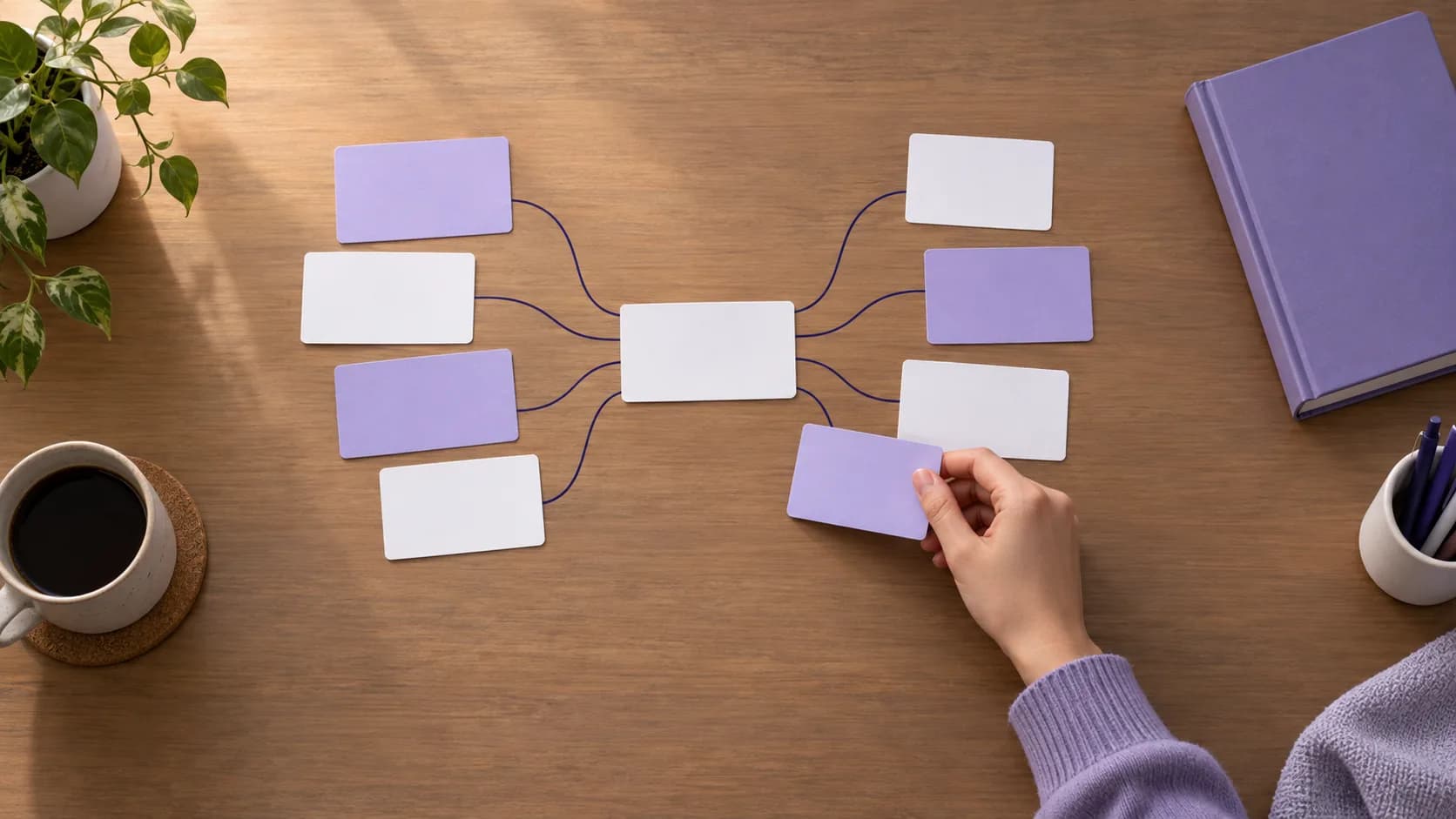
To study for a cumulative exam, first confirm which units and skills the exam covers. Make a short map of those units, then test yourself on older and newer material without notes. Use your mistakes to choose the next topics. Repeat the difficult material across several sessions, mix related topics, and finish with practice under the exam's actual conditions.
A cumulative exam asks you to use material from more than the latest unit. That changes the job: you must recover earlier ideas and recognize when a question combines them. You do not need to reread every page in order. You need a reliable route from the course outline to a practice question, a checked answer, and the source that explains an error.
Quick answer: Map the scope, diagnose gaps, revisit older units, mix practice across units, and check each answer against the course material.
What does a cumulative exam cover?
Ask the instructor or check the syllabus before building a revision system. “Cumulative” usually means that earlier course material can appear again. It does not tell you how much weight each unit receives, which formats appear, or whether a formula sheet is allowed. A course may emphasize recent units while expecting you to apply earlier foundations.
Collect the official scope, learning objectives, past quizzes, feedback, and any permitted practice exam. Mark what remains uncertain. If a sample question appears to conflict with the syllabus, ask your instructor instead of guessing its weight.
Sort the requirements by skill, not only by week. A statistics exam may revisit probability definitions inside a later hypothesis-testing problem. A history exam may ask you to compare a recurring cause across several periods. An anatomy exam may require an earlier structure to explain a newer process.
Build a course map before you start reviewing
Make one row for each unit or major objective. Add the source you would use to check an answer and one task that proves understanding.
- Probability foundations: Check Lecture 3 and tutorial 2. Explain conditional probability, then solve a new problem. Status: needs practice.
- Sampling: Check Lecture 6 and chapter 5. Choose a sampling method for a scenario. Status: unchecked.
- Hypothesis tests: Check Lectures 9–10 and problem set 4. Select and justify the test. Status: needs feedback.
Keep the map small enough to use during a study session. Do not copy the complete lecture outline into every cell. A link or exact page reference should take you back to the source when you need detail.
If notes sit in several places, first give each course and unit a stable home. Nested folders for study notes support that structure without forcing all units into one document. Our guide to organizing study notes digitally explains the basic folder layer. This article focuses on how to use that layer for cumulative practice.
Diagnose older material with a closed-note attempt
Begin with a short diagnostic from across the course. Choose one question or problem per unit, including an older unit you believe you remember. Close the notes and try each task under a modest time limit. Then mark the result:
- Can explain and apply: the answer works, and you can justify the method.
- Partly recalled: you know a definition, but cannot use it in a new setting.
- Needs repair: the approach, evidence, or calculation fails.
- Not tested: you have not attempted a representative question.
Do not treat recognition as a pass. A highlighted solution can look familiar while the next blank problem remains difficult. Carnegie Mellon University's retrieval-practice guidance describes recall followed by feedback. After each attempt, reopen the relevant source and identify the exact difference between your answer and the expected one.
Keep an error record with four fields: question, what I did, what the source shows, and next practice task. “Review chapter 6” is too broad. “Choose between the two tests without a formula hint” gives you a task you can repeat.
Revisit older units across several sessions
Place older topics in more than one study session. Use each return to retrieve first and check second. Indiana University's spaced-practice guidance recommends returning to earlier concepts and quiz questions, especially for cumulative exams. The guidance does not prescribe one universal interval for every learner or course.
Here is a flexible seven-day example when the scope is already known:
- Day 1: Map all units and try a short diagnostic from each.
- Day 2: Repair two weak foundations and solve fresh questions.
- Day 3: Study newer units, then retrieve one older unit again.
- Day 4: Mix problems from several units without unit labels.
- Day 5: Revisit errors and explain connections between units.
- Day 6: Try a practice exam with the permitted resources and time limit.
- Day 7: Check recurring errors, ask unresolved questions, and rest appropriately.
Adjust this order to your calendar and exam format. If you have only two days, shorten the map and protect time for one diagnostic and one mixed practice set. If you have several weeks, revisit weak topics repeatedly instead of stretching one rereading session across the entire syllabus.
The map is a study tool, not a promise that every unit deserves equal time. Spend more time where the exam requires a skill that your attempts show you cannot yet perform. Keep a small return slot for older material that seems strong, so it does not disappear from practice.
Mix topics when you can solve them separately
First learn or repair a method in a focused block. Then mix questions that require you to choose among methods. A question set that announces “Unit 4: hypothesis tests” removes one decision the exam may require.
Cornell University's effective study strategies distinguish retrieval, spaced practice, and interleaving. Interleaving means practising several related skills or concepts together. Mixing is useful when the question requires you to identify which idea or method applies.
For example, a mixed statistics set might ask you to interpret a graph, choose a sampling method, and justify a test. Do not label each question with its source unit. After answering, write which cue led you to a method and why an alternative did not fit. Then check the explanation against lecture notes or an official solution.
In a reading-heavy course, mix prompts that ask for comparison, evidence, and counterarguments from different units. Avoid turning everything into definition flashcards. A cumulative essay can require a relationship between two ideas that never appeared together in one lecture.
Connect units without replacing the original notes
When a later unit depends on an earlier one, keep both source notes intact. Add a short relationship between them:
Lecture 9 uses the sampling assumption explained in Lecture 4; check that assumption before choosing the test.
This statement tells you why to revisit the older note. A bare “related” link does not. Links and backlinks can show such relationships across course folders. Use them for prerequisites, applications, exceptions, and corrections, not for every repeated term.
For a mixed revision session, select the relevant older and newer notes together. BrainDen's multi-note reading feature lets you read selected notes continuously and export them as one document. It does not create a new merged stored note. The original notes still keep their source context and can be corrected independently.
Our guide to combining lecture notes for exam revision gives a more detailed method for a single exam topic. For a cumulative exam, repeat that selection across the whole course map, with special attention to older foundations.
Practice in the format you will face
Match at least one practice session to the exam's real constraints. Stanford's week-prior test preparation guide recommends a practice test with similar timing, resources, and surroundings when possible. If you cannot obtain an official practice test, assemble representative course questions. Mark your set as self-made so you do not mistake it for the instructor's likely exam.
Choose the task that fits the format:
- Problem-solving exam: solve new problems without hints and explain each method choice.
- Short-answer exam: write a full answer from memory before checking terms and evidence.
- Essay exam: outline a claim, examples from several units, and a limitation under time pressure.
- Oral exam: explain a concept aloud, then answer a follow-up that changes the context.
- Open-book exam: practise locating a source quickly while still forming the answer yourself.
An open-book cumulative exam needs a different navigation setup. See our open-book exam note guide for a source index and timed lookup method. Do not assume that access to notes removes the need to understand relationships between units.
After practice, sort errors by cause. Did you forget a fact, select the wrong method, misread a condition, run out of time, or lack a source reference? Each cause needs a different response. Rereading a whole chapter rarely fixes a repeated decision error by itself.
What if your notes are incomplete?
Start with the official course outline, then locate the source for each missing objective. Ask a classmate or instructor for permitted material when a lecture or assignment is missing. Label a borrowed or generated note as a working draft until you compare its claims with the original source.
Do not invent a complete study guide from fragments. Record uncertainty, exact page numbers, and questions for office hours. If a previous quiz contains feedback, use it to identify the reasoning error, not merely to copy the correct answer.
You can still make progress with incomplete notes. Test the objectives that have reliable sources, keep gaps visible on the map, and return to those gaps when the source becomes available.
A final cumulative-exam checklist
Before the exam, confirm that you can:
- name the tested units and any uncertain boundaries
- retrieve an older concept without viewing its answer
- choose a method when questions from different units are mixed
- explain at least one dependency between an early and a late unit
- correct a practice error with an exact source or instructor explanation
- complete a representative task under the actual time and resource rules
The goal is not a perfect summary of the semester. The goal is to identify what the exam asks, attempt it honestly, and repair specific gaps. Keep the source, the unit map, and the practice result connected so you know what to review next.
Review selected course notes together with BrainDen, then choose Web, iPhone & iPad, or Android in the shared study block.
Turn your next source into a study system.
Create structured notes, flashcards, quizzes, mind maps, and active-recall practice from your own material.