
Work chapter by chapter
A coherent section produces a more diagnostic quiz than a large book containing unrelated topics, examples, appendices, and reference material.
A whole textbook contains more detail than one useful quiz can test. Import a permitted chapter or focused PDF section into BrainDen, review the structured note against headings, figures, definitions, and worked examples, then use a connected quiz to find which concepts and applications need another pass.
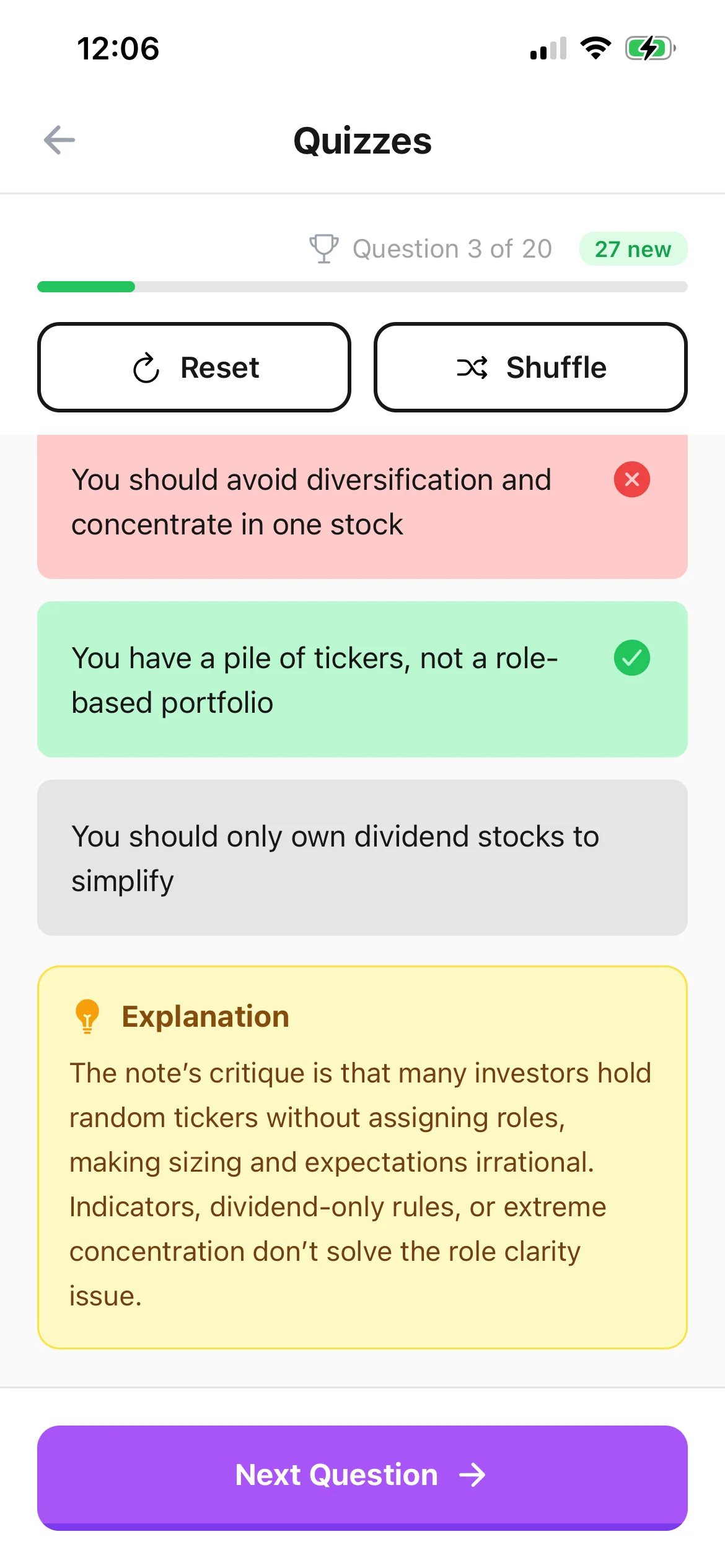
A coherent section produces a more diagnostic quiz than a large book containing unrelated topics, examples, appendices, and reference material.
Use questions to compare ideas, order processes, interpret examples, and apply rules instead of checking only whether a definition looks familiar.
Return from missed answers to the attached chapter for exact notation, diagrams, evidence, exceptions, and worked reasoning that short feedback cannot fully preserve.
Workflow fit
From source to active study
Use the syllabus, lecture, or practice objective to select one relevant section and confirm that you have permission to upload the material.
Compare headings, terms, figures, formulas, and examples with the source. Add the instructor's emphasis and correct details before opening the quiz.
Commit without viewing the chapter, classify each gap, return to the exact source section, and try a related question after a delay rather than immediately repeating it.
A concrete example
A chapter covering incidence, prevalence, risk, rates, screening accuracy, causal inference, and worked population examples with tables.
A useful result could include
Generated material is a study aid. Review important terminology, notation, and claims against your source.
Make the result better
BrainDen removes repetitive setup work. Your judgement, course context, and retrieval practice are what turn the result into learning.
Not every paragraph needs a question. Prioritize the concepts and applications required by the course, while keeping supporting detail in the note.
Figures, equations, tables, captions, and worked layouts may carry meaning that extracted prose cannot represent completely. Verify them in the attached PDF.
After reading feedback, state the correct definition, relationship, or calculation route in your own words before moving to the next question.
Questions and answers
Yes. Import a permitted PDF chapter, review the structured note, and open its connected quiz view. Focused chapters are easier to verify.
A chapter or focused section is usually more useful. It keeps the questions aligned with one objective and makes every answer easier to check.
Check them directly in the attached source and add necessary visual or notation context to the note before relying on related questions.
Yes. File the chapter note with its module, link it to relevant lectures, and read selected notes together when revising the wider topic.
Continue in your connected library
A growing study library should match the way your course is actually structured. Build folders inside folders so lectures, readings, assignments, and revision topics stay easy to find.
Explore this featureConnect related ideasFolders tell you where a note belongs. Links show how its ideas relate to the rest of what you know. Connect a concept to another lecture, reading, or course and use backlinks to find the relationship from either side.
Explore this featureReview the whole topicExam topics rarely fit inside one note. Select the lectures, readings, and explanations that belong together, then review them in one continuous view without replacing or rewriting the originals.
Explore this featureKeep building your study system
Start with one textbook chapter or a focused PDF section, create a connected note, and choose the study tools that help you understand and remember it.