
Test arguments before authors
Present premises and a conclusion, then ask what follows, which assumption remains hidden, or where an objection applies.
A useful philosophy quiz tests conceptual distinctions, argument reconstruction, inference, thought experiments, objections, replies, and evaluation. It should not reward recognition of quotations or thinker names alone. Bring one bounded text or problem into BrainDen, verify every source passage, and use each miss to locate a conceptual, interpretive, premise, inference, counterexample, objection, or evaluation gap.
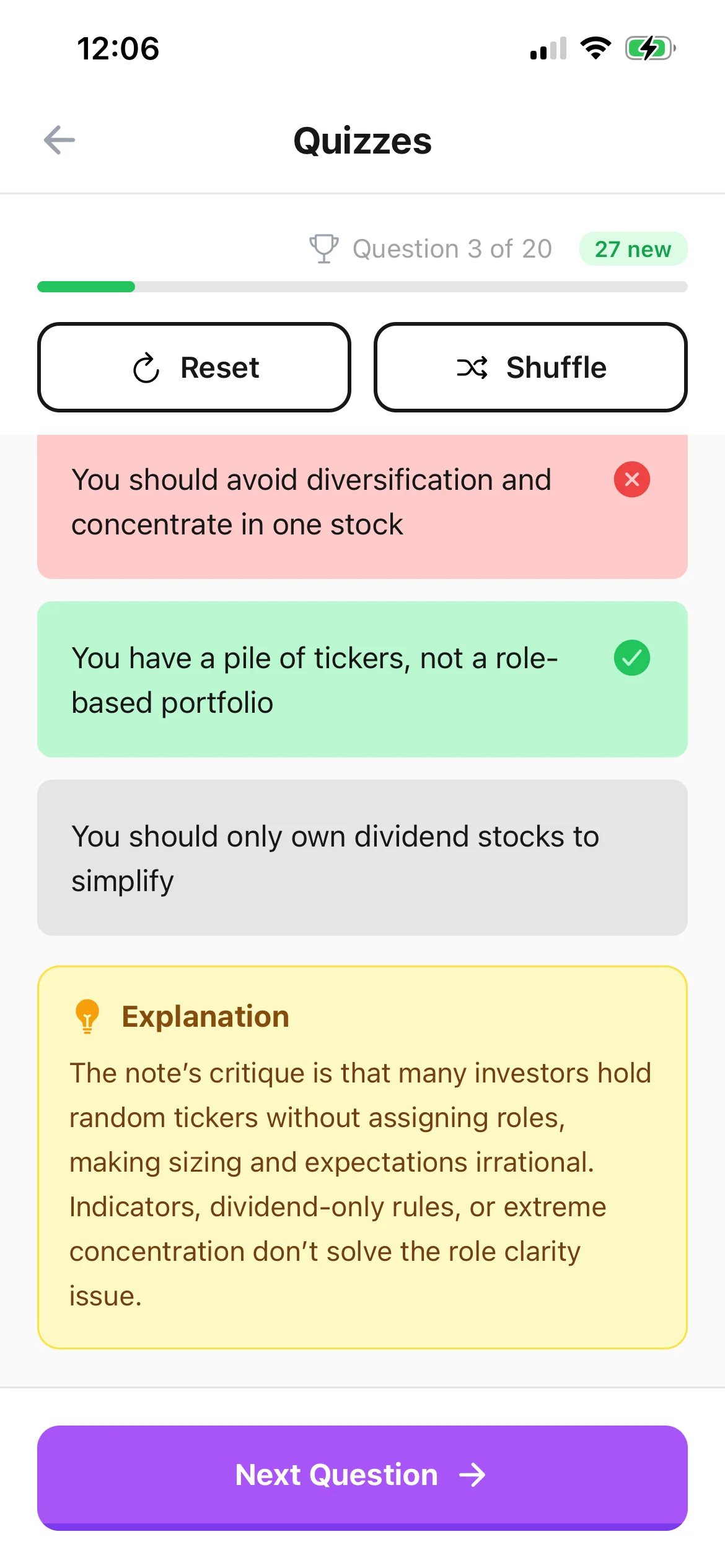
Present premises and a conclusion, then ask what follows, which assumption remains hidden, or where an objection applies.
Distractors should expose a reversed inference, equivocation, category error, missing distinction, weak analogy, or objection aimed at the wrong claim.
Ask for the strongest source-supported version of a position before inviting criticism or a preferred conclusion.
Workflow fit
From source to active study
Set one passage, debate, edition, terminology set, argument structure, course interpretation, and assessment level before generating questions.
Commit before feedback, then state the premise, distinction, example, or logical relation that supports the selected answer.
Classify the miss as concept, passage, premise, inference, objection, reply, or evaluation, correct it from the source, and retry.
A concrete example
Checked course notes and assigned passages on consequences, duties, character, a bounded thought experiment, objections, replies, and interpretive limits.
A useful result could include
Generated material is a study aid. Review important terminology, notation, and claims against your source.
Make the result better
BrainDen removes repetitive setup work. Your judgement, course context, and retrieval practice are what turn the result into learning.
Check quotations, translations, page numbers, technical terms, and surrounding argument against the exact assigned edition.
Some questions permit several defensible conclusions. Grade the stated reasoning, evidence, and fit with the assigned framework.
Rebuild truth tables, derivations, symbolizations, or validity tests step by step using the notation and rules required by your course.
Questions and answers
Yes. Bring in one bounded text or topic, verify the passages and arguments, and use the connected quiz for practice.
Test concepts, distinctions, premises, inferences, conclusions, thought experiments, objections, replies, interpretations, and evaluation.
No. Use single-answer questions for clear source or logic checks, and use written analysis for defensible interpretive or evaluative disputes.
Check the assigned edition, passage, terminology, premises, inference, conclusion, objection, reply, and course interpretation.
Continue in your connected library
Folders tell you where a note belongs. Links show how its ideas relate to the rest of what you know. Connect a concept to another lecture, reading, or course and use backlinks to find the relationship from either side.
Explore this featureReview the whole topicExam topics rarely fit inside one note. Select the lectures, readings, and explanations that belong together, then review them in one continuous view without replacing or rewriting the originals.
Explore this featureKeep building your study system
Start with checked philosophy notes, primary texts, arguments, objections, and course terminology, create a connected note, and choose the study tools that help you understand and remember it.