
Map the complete inference
Pair a conclusion with the premises and reasoning that support it instead of attaching the position to a thinker by name alone.
Philosophy flashcards should preserve the difference between a claim, premise, inference, objection, reply, and conclusion. A short slogan linked to a thinker can distort the argument and hide important qualifications. Bring one bounded text or topic into BrainDen, verify wording against the assigned edition, and create prompts that support argument reconstruction, conceptual distinction, objection, reply, and independent evaluation.
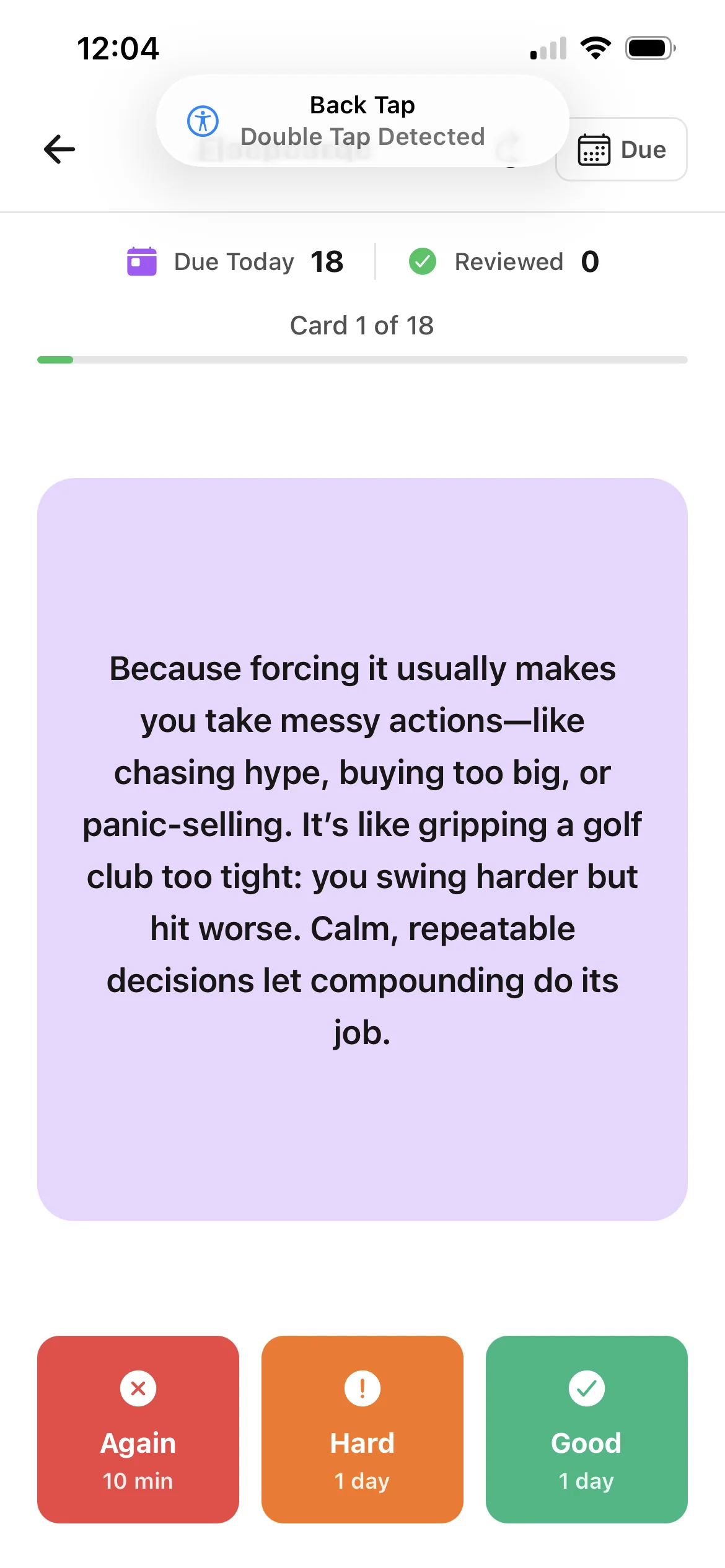
Pair a conclusion with the premises and reasoning that support it instead of attaching the position to a thinker by name alone.
Use separate prompts for terms that appear similar, then state the criterion and example that makes the difference clear.
Recall which premise an objection targets, why it matters, and how the assigned author or later view responds.
Workflow fit
From source to active study
Choose a bounded passage, debate, or argument and verify key terms, translations, premises, conclusions, objections, and course readings.
Ask for one definition, distinction, premise, inference, objection, reply, example, or counterexample without removing needed context.
After recall, state the argument in its strongest form, test a new case, and explain whether the objection changes the conclusion.
A concrete example
Checked course passages and notes on justified belief, a counterexample, the targeted inference, proposed repairs, and stated limits.
A useful result could include
Generated material is a study aid. Review important terminology, notation, and claims against your source.
Make the result better
BrainDen removes repetitive setup work. Your judgement, course context, and retrieval practice are what turn the result into learning.
Verify quotations, page numbers, translations, technical terms, and editorial notes against the exact primary text used by your course.
Do not reduce a position to a name and slogan. Preserve the argument, qualifications, context, and interpretive uncertainty.
First present the argument fairly. Then identify the premise, inference, example, or consequence that your evaluation challenges.
Questions and answers
Yes. Bring in one bounded text or topic, verify the arguments and terminology, and open its connected flashcard view.
Use concepts, distinctions, premises, inferences, conclusions, arguments, thought experiments, objections, replies, examples, and counterexamples.
No. Use cards for precise recall, then reconstruct arguments, assess objections, develop examples, and write complete analysis independently.
Verify the wording, author, work, edition, translator, page, context, and course interpretation against the assigned text.
Continue in your connected library
Folders tell you where a note belongs. Links show how its ideas relate to the rest of what you know. Connect a concept to another lecture, reading, or course and use backlinks to find the relationship from either side.
Explore this featureReview the whole topicExam topics rarely fit inside one note. Select the lectures, readings, and explanations that belong together, then review them in one continuous view without replacing or rewriting the originals.
Explore this featureKeep building your study system
Start with checked philosophy notes, primary texts, arguments, objections, and course terminology, create a connected note, and choose the study tools that help you understand and remember it.