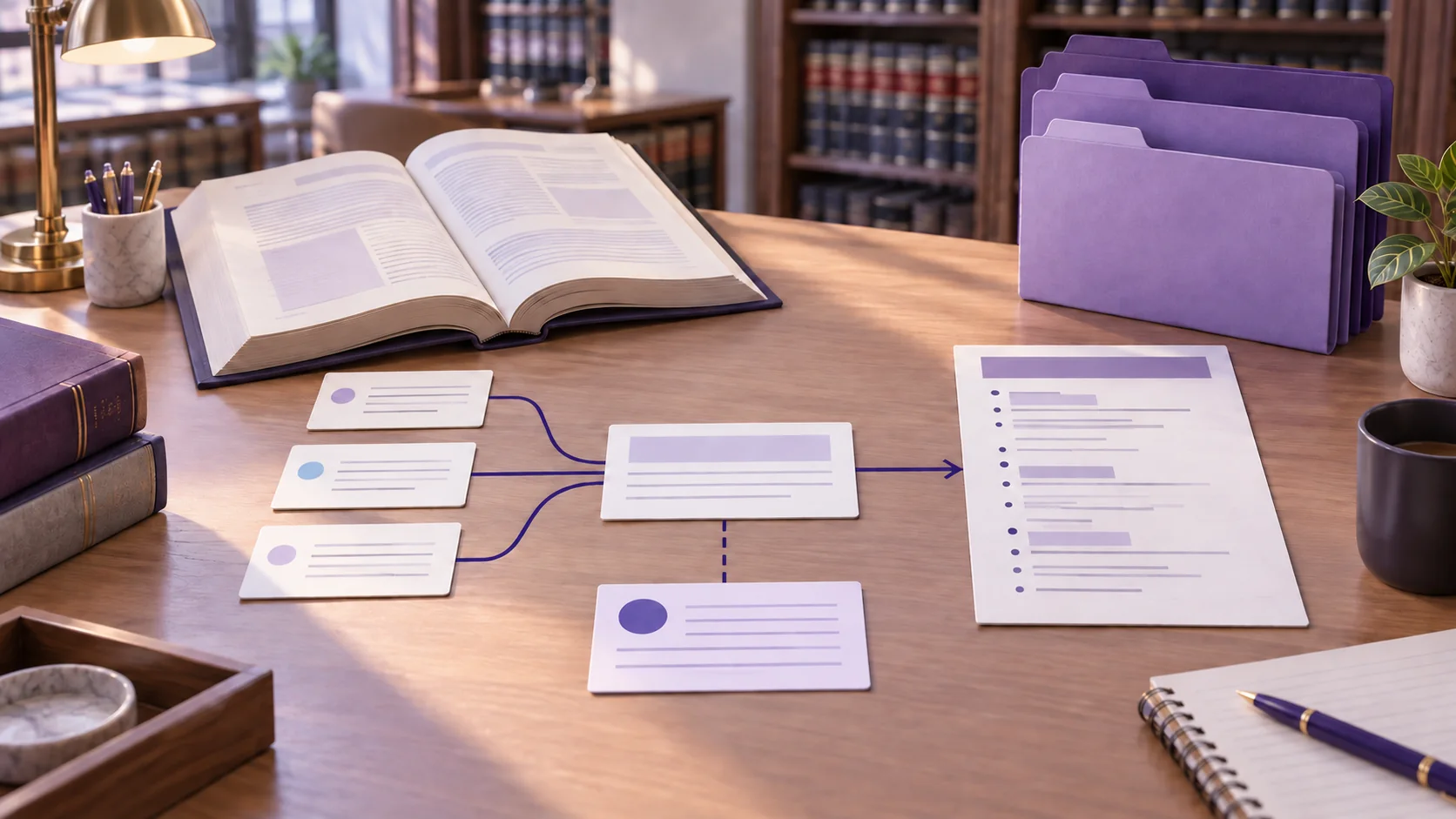
To organize law school notes, create one course folder, follow the syllabus for your topic structure, and keep reading briefs separate from class notes. After each class, add the professor's explanations and hypotheticals to the relevant topic. Then update a shorter course outline every week. Connect each rule to its cases, exceptions, and practice problems, so your notes support analysis rather than simple recall.
The system needs three layers: source notes for detail, a course outline for structure, and practice material for application. Do not force all three jobs into one document.
Quick answer: File notes by course and syllabus topic. Keep case briefs and class notes traceable. Build your own outline from both. Add short links between rules, cases, exceptions, and hypotheticals. Test the outline with practice questions before the exam.
Why law school notes need more than one document
Law school produces several types of material. A case brief prepares you to discuss one opinion. Class notes record the professor's emphasis, questions, and hypotheticals. A course outline organizes the rules and relationships across the semester. A practice answer shows whether you can use that structure under time pressure.
These materials overlap, but they are not interchangeable. If you paste every case detail into one large outline, important rules become hard to find. If you keep only a compressed outline, you can lose the reasoning or class discussion needed to understand a distinction.
The University of Wisconsin Law School's case briefing guide describes a case brief as a short summary of the significant parts of an opinion. It also explains that briefs support class preparation, course outlines, and exam review. Treat the brief as an input to the wider system, not as the final exam tool.
Use a syllabus-based folder structure
Create one main folder for each course. Inside it, use the syllabus headings before inventing your own categories.
Fall 2026
└── Contracts
    ├── 01 Formation
    │   ├── Reading briefs
    │   ├── Class notes
    │   └── Practice
    ├── 02 Defenses
    ├── 03 Performance and breach
    ├── 04 Remedies
    └── Course outline
This structure follows the order in which the professor teaches the course. It also gives each note a stable location. Georgetown Law's current outlining guide recommends using the syllabus as a starting point, then changing the arrangement when another structure makes more sense.
Do not build a deep folder tree before the course begins. Start with course and topic levels. Add a separate folder only when several related items need it. A folder called Hearsay exceptions can help when it contains many cases and problems. A folder for one short reading usually adds navigation without adding clarity.
BrainDen's nested folders for courses and topics support this semester, course, and unit structure. The same method works in any system that lets you keep a dependable hierarchy.
How to organize law school notes step by step
1. Give every note a traceable title
A title should identify the course, topic, source type, and date or case.
Use a pattern such as:
COURSE | Topic | Source | Date or case name
Examples:
CONTRACTS | Consideration | Class notes | 17 SepTORTS | Duty | Case brief | PalsgrafCIV PRO | Personal jurisdiction | Practice problem 03
Clear titles matter when a search result removes a note from its folder. They also prevent several files called Week 4 from becoming indistinguishable near the exam.
Keep the citation, assigned pages, or class date near the top. If the professor uses a different rule statement or interpretation from a commercial aid, label the source of each version.
2. Brief cases for retrieval, not transcription
Use a repeatable case-brief template. Keep it short enough to scan before class.
Case and citation:
Procedural posture:
Material facts:
Issue:
Rule:
Holding:
Reasoning:
Separate opinions:
Why this case appears here:
Questions:
The final field is important. Why this case appears here forces you to connect the opinion to the syllabus topic. It might introduce a rule, show an exception, demonstrate a policy conflict, or limit an earlier case.
Do not copy long passages when a page reference will preserve the source. Keep exact quotations only when the wording matters. Mark uncertain points before class instead of turning a guess into a settled statement.
3. Keep class notes beside the reading notes
Create a dated class note for each session. Start with the assigned topic and the questions left by your reading. During class, record what changes your understanding:
- the professor's rule formulation
- repeated or emphasized distinctions
- a hypothetical and the facts that change its result
- how two cases fit together
- a policy argument or counterargument
- a correction to your reading brief
- an exam instruction or format detail
Georgetown Law's class note-taking guide recommends reading the syllabus for the professor's goals and listening for summaries, emphasis, and repetition. These signals help you decide what deserves space in your notes.
Do not record every spoken sentence. Leave a marker when you miss a point, then resolve it from a permitted recording, a classmate, office hours, or the assigned source. Follow your school's rules for recording and sharing course material.
4. Link rules to cases, exceptions, and hypotheticals
Folders tell you where a note belongs. Links explain how the legal ideas relate.
For each important rule, connect the notes that:
- establish or illustrate the rule
- limit the rule
- create an exception
- disagree about the reasoning
- apply the rule to a new fact pattern
- show the professor's preferred analysis
Write a relationship phrase beside each link. Compare with Case B is more useful than Related notes. A useful sentence might say:
Case B limits this rule when the promise leaves performance entirely optional.
That sentence preserves the legal relationship without combining the two case briefs. Links and backlinks can also reveal which later topics depend on an earlier rule. Our guide to using bidirectional links for studying explains how to add relationships without creating a noisy graph.
5. Build your course outline every week
Your outline should organize the course, not reproduce your notebook. Start with the syllabus headings. Add the rule, its elements, exceptions, leading cases, and one useful hypothetical.
For one section, the structure may look like this:
Consideration
1. Bargained-for exchange
   - Rule and elements
   - Case that illustrates the exchange
   - Limits and exceptions
   - Professor's hypothetical
   - Unresolved question
Update the outline after the week's classes. This creates a regular compression step while the discussion is still recent. It also reveals missing rule statements and unclear case relationships early.
Make the outline specific to your course. Georgetown's exam outlining guidance advises students to make their own outline and adapt it to the professor and course. An old outline can help you check coverage, but it may use different cases, priorities, or law.
6. Keep source notes and the outline connected
When you add a rule or case to the outline, keep a route back to the detailed note. A short link or exact title is enough.
This lets you compress without losing context. If a practice problem exposes uncertainty about an exception, you can return to the class discussion, case reasoning, or source page. Correct the detailed note first, then update the outline.
Do not paste the same full explanation into several documents. Copies drift apart when you correct one version. Keep detail in its source note and use the outline as a navigable map.
7. Create a separate practice layer
Create a Practice folder for hypotheticals, past exams, issue checklists, and your own answers. Name each item by topic and attempt date.
After an attempt, record:
- issues you missed
- rules you could not state precisely
- facts you failed to use
- counterarguments you ignored
- outline sections that were hard to navigate
Then revise the source note or outline that caused the problem. Georgetown's updated outlining guide recommends testing the outline on a practice exam. It notes that practice can reveal missing content and navigation problems before the real exam.
Follow your professor's instructions about permitted materials and exam software. An open-book exam can still restrict internet access. Keep any permitted outline available in the required format.
A worked example for one Contracts topic
Suppose the syllabus reaches consideration. You prepare separate briefs for the assigned cases. Each brief records the rule, reasoning, and the case's role in the unit.
During class, the professor changes one fact in a hypothetical and asks whether the promise becomes illusory. You record the changed fact and the reasoning, not only the answer. You then link that class note to the case brief that supplies the limit.
At the end of the week, the course outline gets one Consideration section. It contains the main rule, elements, exceptions, two case names, and the professor's hypothetical. The full facts remain in the briefs.
For practice, you answer a short problem without opening the notes. You identify the consideration issue but miss an exception. You check the linked case, correct the rule statement, and add one line to the outline. The system improves because practice sends you back to the exact weak point.
Common law school note-organization mistakes
One document for everything
A single file can become slow to scan and difficult to revise. Separate source notes, course structure, and practice results. Connect them with titles and links.
Outlining only before finals
Late outlining turns organization into emergency transcription. A short weekly update keeps the workload smaller and exposes gaps sooner.
Treating every case detail as equally important
Keep enough detail to understand the reasoning and answer class questions. In the course outline, preserve the rule, relationship, and facts that change the analysis.
Using an old outline as the main source
Another outline can omit your professor's emphasis or reflect older law. Use it as a check, not as a substitute for your own course materials.
Collecting notes without applying them
Clean notes do not show whether you can analyze a new fact pattern. Use practice questions to test both your understanding and your filing system.
A weekly law school notes checklist
Before the week ends, confirm that:
- each case brief has a clear role in the topic
- class notes record emphasis, distinctions, and hypotheticals
- unresolved points have a specific question and source
- the course outline reflects the week's rules and exceptions
- links explain relationships between rules, cases, and problems
- one short practice attempt tests the new section
- corrections appear in both the source note and outline where needed
Start with one course and one week. A small system you update is more useful than a complete-looking archive you cannot test.
Organize your law school notes by semester, course, and topic with BrainDen, then choose Web, iPhone & iPad, or Android in the shared study block.
Turn your next source into a study system.
Create structured notes, flashcards, quizzes, mind maps, and active-recall practice from your own material.