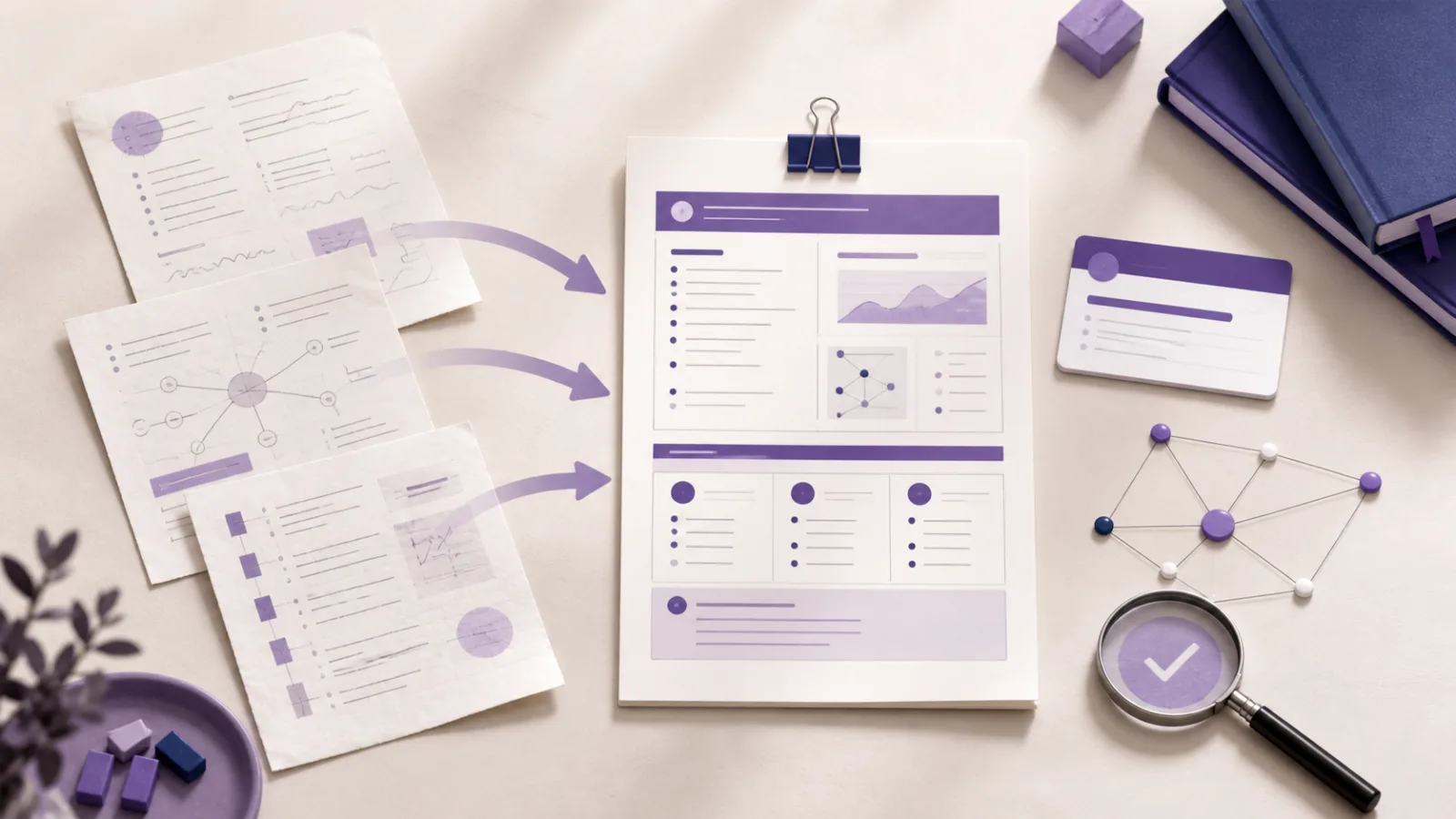
To create a study guide from lecture notes, start with the exam scope, group related lectures by topic, and turn each topic into questions you must answer. Condense the notes only after checking them against slides, readings, and the syllabus. Keep one example or application beside each core idea. Then close the guide and answer its questions from memory.
A useful study guide is not a shorter copy of every lecture. It is a checked route through the material: what you need to know, how the ideas connect, where each answer came from, and how you will test yourself.
What makes a study guide different from lecture notes?
Lecture notes follow the class. They often preserve the order of explanations, examples, questions, and announcements. A study guide follows a learning objective or exam topic instead.
That change of structure matters. One exam question may depend on a definition from week two, a model from week four, and an application from week seven. Copying all three lectures into one document leaves you with more material, but not necessarily a clearer answer.
A good study guide has five parts:
- a defined scope
- questions or objectives that organize the material
- concise answers supported by examples
- links back to the original notes and sources
- practice that requires recall or application
Stanford's Center for Teaching and Learning recommends using a consistent note system within one class. Consistency makes it easier to connect different lectures and readings. Its guide to organizing your notes also stresses keeping notes where you can find and review them.
What should you collect before making the guide?
Gather only the material that can answer your chosen objective. That may include:
- lecture notes
- slide decks or lecturer handouts
- assigned readings
- tutorial problems
- the syllabus or exam guidance
- marked assignments and practice questions
Do not begin by pasting everything into one long document. First write the boundary at the top of the page.
For example:
Scope: Explain classical conditioning, distinguish it from operant conditioning, and apply both models to unfamiliar examples from weeks 3 to 5.
This sentence helps you reject material that does not serve the current guide. It also reveals missing sources before you start condensing.
How to create a study guide from lecture notes step by step
1. Start with the exam scope or learning objective
Use the syllabus, module outcomes, revision sheet, or lecturer guidance. Write one to three outcomes that you can test.
Weak objective:
Review the nervous system.
Better objectives:
- compare the sympathetic and parasympathetic systems
- trace a signal through a simple reflex arc
- predict the effect of damage at three points in that pathway
If the exam scope is unclear, use lecture titles and repeated themes as a temporary map. Mark that map as provisional instead of treating it as confirmed exam guidance.
2. Gather related notes without removing their context
Select the lectures, readings, and examples that answer the objective. Record each source beside the section where you use it. A simple source key works:
L3 = Lecture 3 notes and slides
L4 = Lecture 4 notes and slides
T2 = Tutorial 2 problems
R1 = Assigned reading, pages 44-58
Keep the original notes separate. You may need their fuller explanations, diagrams, or lecturer comments when a condensed sentence becomes unclear.
If you already manage several lecture files, the guide to combining lecture notes for exam revision explains how to review related notes without replacing the originals. BrainDen's multi-note reading feature can also place selected notes in one continuous view while each note stays separate.
3. Audit the notes for gaps and conflicts
Before summarizing, compare your notes with the slides, readings, and stated objectives. Look for:
- a heading with no explanation
- a formula without its conditions
- a diagram you cannot explain
- two lectures using different terms for the same idea
- a claim that does not match the assigned reading
- an example without the principle it demonstrates
- a topic from the syllabus that your notes do not cover
Use labels such as CHECK, MISSING, or ASK instead of filling gaps from memory. A confident guess can become harder to detect after you polish the guide.
4. Turn topics into answerable questions
Questions give the guide a purpose. They also prepare it for active recall.
For a biology topic, you might use:
- What starts the process?
- Where does each stage occur?
- What enters and leaves each stage?
- Which conditions change the outcome?
- How would the process change in a new example?
Use question types that match the course. History guides need causes, consequences, evidence, and competing interpretations. Mathematics guides need conditions, method choices, worked problems, and error checks. Literature guides need claims, textual evidence, context, and alternative readings.
5. Write the smallest complete answer
Answer each question in your own words. Keep the explanation complete enough to reconstruct the idea, but short enough to review.
A useful answer often contains:
- one direct statement
- the essential steps or relationship
- one example
- one exception, limitation, or common confusion
- a source reference
Do not remove every detail. Remove details that do not help you answer, explain, distinguish, or apply the topic.
For a process, use numbered steps. For a comparison, use a table. For a hierarchy, use a small outline. For a relationship, use a concept map only when the connections are more important than the sequence.
6. Add a source check beside every uncertain point
AI and manual summaries can both repeat weak source material. Check names, dates, definitions, formulas, quotations, and causal claims against the course source.
Use precise references where possible:
Definition: L3, slide 14
Exception: R1, page 52
Worked example: T2, question 4
Still unclear: ask about the boundary condition in L4
This does not mean every sentence needs a formal citation. It means you can return to the evidence when an answer looks incomplete or conflicts with another note.
7. Turn the guide into retrieval practice
The guide is ready when you can study without keeping every answer visible.
Cornell's Learning Strategies Center describes retrieval practice as recalling information and putting it on paper in forms such as writing, diagrams, or flow charts. Its effective study strategies guide notes that a blank-page attempt reveals what you understand and what needs more work.
Try this sequence:
- Hide the answer to one guide question.
- Answer aloud, on paper, or in a blank document.
- Compare your answer with the checked guide.
- Label the exact gap.
- Correct the answer without copying it.
- Return to the question after a delay.
Carnegie Mellon University's retrieval-practice guide includes quizzes, flashcards, practice problems, concept maps, and student-created study guides as useful recall tasks. Choose the format that matches what the exam requires you to produce.
Worked example: three neuroscience lectures
Imagine that an exam covers resting potential, action potential, and synaptic transmission across three lectures.
The raw notes contain repeated definitions, two incomplete diagrams, and several examples. A focused guide could use this structure:
Objective 1: Explain how a resting potential is maintained
- Direct answer
- Ion distribution table
- Role of selective permeability
- Common confusion: equilibrium potential is not resting potential
- Sources: L2 slides 8-17, textbook pages 91-96

Objective 2: Trace an action potential
- Threshold and depolarization
- Repolarization and refractory period
- Worked graph with labelled phases
- Application: predict the effect of a blocked sodium channel
- Sources: L3 slides 4-22, tutorial question 6

Objective 3: Explain chemical synaptic transmission
- Seven-step sequence
- Excitatory versus inhibitory response
- Link to the earlier membrane-potential section
- Sources: L4 slides 5-19
The final practice should not ask only for three definitions. It should include a blank action-potential graph, a sequence reconstruction, and one unfamiliar channel-blocking scenario. Those tasks test the structure and application of the topic.
Should you make the study guide manually or with AI?
Use the method that preserves checking and active effort.
A manual guide gives you direct control over selection and wording. It can work well when the course is narrow or the act of writing helps you notice relationships.
An AI-assisted guide can draft headings, questions, summaries, and practice items from several lecture notes. It is useful when the material is long or scattered. You still need to set the scope, compare the draft with the sources, remove unsupported details, and adapt the questions to your course.
Do not judge the result by length or polish. Ask four questions:
- Does every required topic appear?
- Can I trace important answers to the source?
- Does the structure show how ideas relate?
- Can I use it without seeing the answers?
A reusable lecture-notes study guide template
Course and exam:
Guide scope:
Learning objectives:
Source key:

Topic 1 question:
Direct answer:
Steps or relationship:
Example or application:
Exception or common confusion:
Source check:
Practice prompt:

Topic 2 question:
Direct answer:
Steps or relationship:
Example or application:
Exception or common confusion:
Source check:
Practice prompt:

Missing or uncertain points:
Next review date:
Common study guide mistakes
Copying every lecture in order
This preserves the timetable, not the exam logic. Organize by objective, topic, or question.
Making the guide too short to explain anything
A list of terms may help recognition. It may not support explanation or application. Keep examples, conditions, and relationships where they matter.
Treating a generated guide as a checked source
Return to the lecture notes, slides, readings, or tutorial solutions. Mark unresolved gaps clearly.
Creating only easy flashcards
Definitions have a place, but the guide should also support comparison, sequencing, problem solving, and explanation.
Waiting until every lecture is finished
Build one topic guide while the material is still familiar. Update it when later lectures add evidence, exceptions, or applications.
Final study guide checklist
Before you revise, confirm that:
- the scope matches your course guidance
- related lectures are grouped by topic
- every objective has an answer
- important claims trace back to a source
- examples and exceptions remain visible
- uncertain points are labelled
- practice questions hide the answer
- the next review happens after a delay
A study guide works when it makes the material easier to verify and harder to only reread. Start with one exam topic, build a checked question-and-answer structure, and use every gap to direct the next review.
Turn selected lecture notes into a checked, active study guide with BrainDen, then continue with the recommended option for Web, iPhone & iPad, or Android.
See BrainDen more often in Google
Choose BrainDen as a preferred source for your Google Top Stories.
Turn your next source into a study system.
Create structured notes, flashcards, quizzes, mind maps, and active-recall practice from your own material.