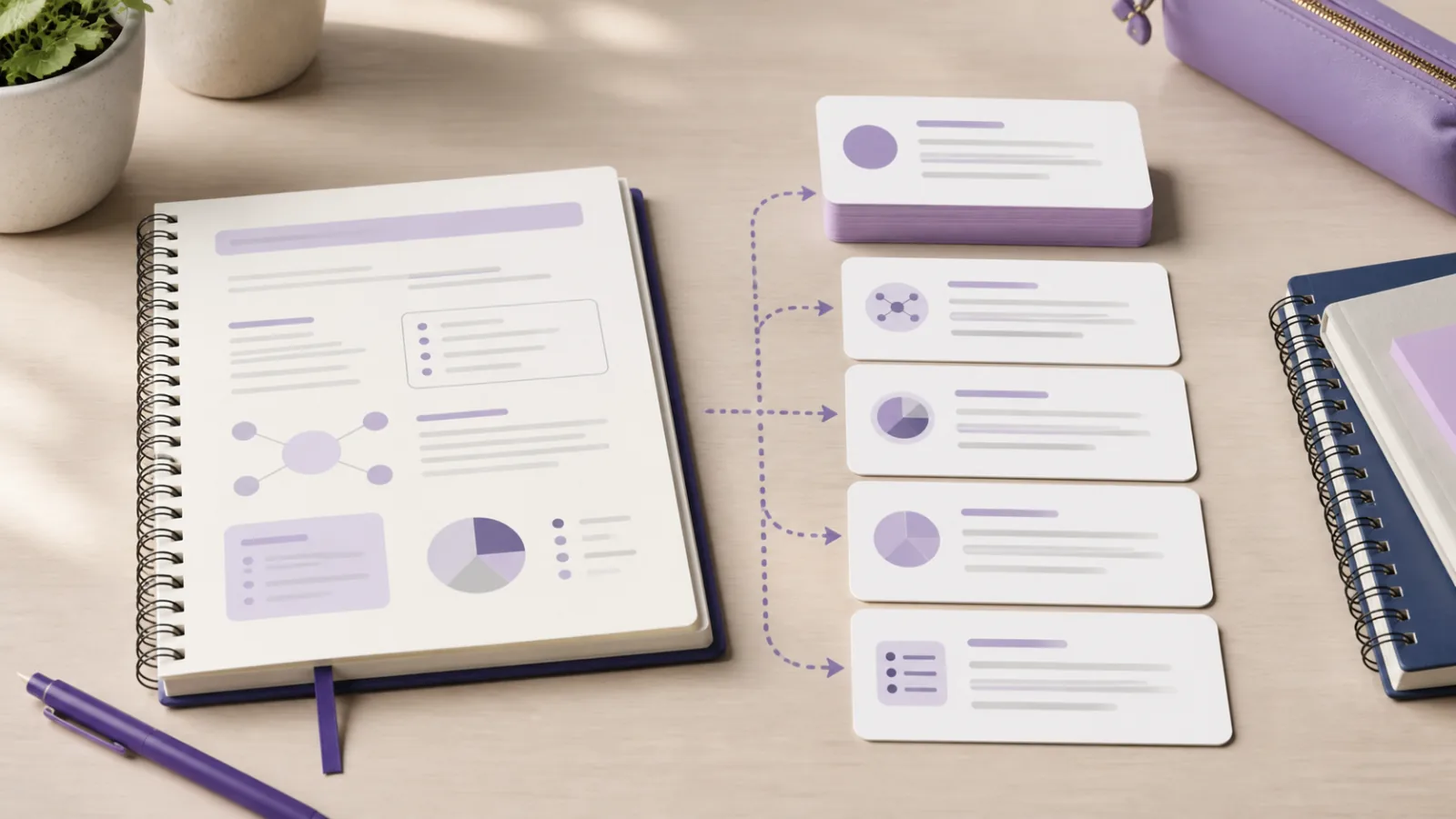
To create flashcards from lecture notes, first clean one lecture note and mark the ideas worth retrieving. Turn each definition, relationship, process, comparison, or small application into a focused question. Put a short, checkable answer on the other side. Keep fuller explanations in the original note. Then answer every card before revealing it, correct weak cards, and review them again after a delay.
AI can draft the first set, but it cannot decide what your lecturer meant in an unclear passage. Check names, formulas, examples, and course-specific wording before you practise them repeatedly.
What makes a lecture-note flashcard useful?
A lecture note records context. It can include explanations, examples, diagrams, questions, and links to readings. A flashcard has a narrower job. It asks you to retrieve one answer without looking at the note.
The University of California San Diego describes retrieval practice as recalling information from memory before checking the course material. Its guidance includes flashcards, practice questions, and copy-cover-check activities.
A useful card therefore has four parts:
- a prompt that makes you produce an answer
- a response you can judge as correct, incomplete, or wrong
- enough context to identify the course idea
- a route back to the lecture note when the short answer is not enough
Do not copy a complete paragraph onto the answer side. Long answers make it hard to decide whether you recalled the important part. Keep the explanation, evidence, and exceptions in the note.
Prepare the lecture note before making cards
Start with one lecture or one coherent topic. A complete course can contain several models, terms, and assessment types. Processing everything at once makes verification difficult.
Read the note once and repair obvious gaps. Check:
- names, dates, and specialist terms
- equations, symbols, units, and signs
- labels on diagrams and tables
- examples that the lecturer used to explain a rule
- references to slides, readings, or earlier lectures
- points marked as uncertain or incomplete
If the note came from a recording, compare important passages with the transcript or audio. Add visual details that the microphone could not capture. The guide to recording lectures and turning them into study notes explains this source-checking stage.
Do not turn an uncertain sentence into a card. Mark the gap and check an approved course source first.
How to create flashcards from lecture notes step by step
1. Define the learning target
Write one sentence that states what you must do with the lecture material. Use the syllabus, learning outcome, revision sheet, or lecturer guidance when available.
For example:
Explain how membrane transport changes with concentration gradients, energy use, and carrier proteins.
This target prevents you from creating cards for every detail on the page. It also shows which question types the set needs.
2. Mark material that belongs on cards
Look for items that you must recall or use independently:
- precise definitions
- relationships between two ideas
- ordered stages in a process
- conditions, limits, and exceptions
- comparisons that students often confuse
- formulas and the meaning of each term
- small examples that require application
Leave long arguments, complete derivations, and detailed case explanations in the note. A card can ask for one step or decision. The note should preserve the full reasoning.
3. Turn each item into a focused prompt
Write questions that identify one clear task. Avoid vague prompts such as membrane transport or explain week four.
Use prompt forms such as:
- Definition: What is facilitated diffusion?
- Relationship: How does a steeper concentration gradient affect diffusion rate?
- Sequence: What happens after a neurotransmitter binds to its receptor?
- Comparison: How does active transport differ from facilitated diffusion?
- Condition: When does a confidence interval become narrower?
- Application: Which transport mechanism fits this example, and why?
A focused question does not always require a one-word answer. It requires one judging rule. You should know what a complete response must include.
4. Write short answers with essential qualifications
Write the smallest answer that remains accurate. Include a condition when removing it would change the meaning.
Weak card:
- Front: What is active transport?
- Back: It moves things across a membrane.
Revised card:
- Front: Why can active transport move a substance against its concentration gradient?
- Back: It uses energy to power a transport protein that moves the substance against the gradient.
The revised answer names the cause and the mechanism. The full lecture note can still hold pump types, diagrams, and worked examples.
5. Add cards that test meaning, not only terms
Definition cards help you learn course language. They do not test every assessment demand.
Add comparison and application cards when your course expects explanation or problem solving. For example:
A red blood cell enters a hypotonic solution. What happens to water movement, and why?Two studies use the same sample size. One has more variable data. Which confidence interval is wider?Which fact would weaken this legal argument under the rule used in the lecture?
Keep the scenario small. A complete exam problem usually belongs in a quiz, practice paper, or worked solution.
6. Use AI for a draft, then verify every card
An AI tool can find candidate definitions, comparisons, processes, and examples in a lecture note. Give it a narrow instruction. For example:
Create 15 question-and-answer flashcards from this checked lecture note. Ask one clear thing per card. Include definitions, relationships, and three small applications. Do not add facts that are absent from the note.
Review the result before study. Remove duplicate prompts and trivia. Split cards that ask several unrelated questions. Correct any answer that changes the lecturer's wording, loses a condition, or invents a detail.
Pay special attention to:
- equations and notation
- negative words such as
not,except, andunless - names that sound similar in a transcript
- diagrams that text alone cannot explain
- course-specific definitions that differ from a general summary
AI saves drafting effort only when the source and review process stay visible.
7. Organize the set with its course context
Name the set with the course, module, lecture, and topic. BIO102, Module 3, Lecture 7, Membrane Transport is easier to find than Biology cards.
Keep the original lecture note beside the set. If one idea depends on an earlier lecture or assigned reading, record that relationship instead of copying the same explanation again.
A growing library also needs a stable location. Nested folders for courses and modules can keep the lecture note and its study tools inside the correct semester structure.
8. Practise, check, and repair
Read the front and commit to an answer before you reveal the back. Say or write the answer when a mental response feels vague.
The University of Southern Maine's guide to using flashcards recommends answering without peeking, checking the response, and returning missed cards to the review pile. It also suggests asking how a card relates to other ideas and how you would apply it.
When you miss a card, classify the problem:
- Recall gap: You understood the idea but could not retrieve it.
- Understanding gap: You remembered the words but could not explain them.
- Card gap: The prompt was vague or the answer was hard to judge.
- Source gap: The lecture note lacked the needed detail.
Repair the matching problem. Review a recall gap later. Return to the note for an understanding gap. Rewrite a weak card. Check the source when the note is incomplete.
Our guide to active recall with flashcards and quizzes shows how to combine retrieval, checking, delayed review, and explanation practice.
Worked example: one psychology lecture
Imagine a lecture about classical and operant conditioning. The note contains definitions, two experiments, a comparison table, and a classroom example.
First, the student checks the terms unconditioned stimulus, conditioned response, reinforcement, and punishment. They repair one unclear example by returning to the lecture slide.
Next, they create four kinds of cards:
- Definition: What makes a stimulus unconditioned?
- Relationship: How does a conditioned stimulus gain its effect?
- Comparison: How does negative reinforcement differ from punishment?
- Application: A student studies more because a weekly quiz is removed. Which process does this example show, and why?
The experimental methods and full classroom discussion stay in the lecture note. The cards point to the ideas that the student must retrieve.
During review, the student can state both definitions but confuses the application. They return to the comparison table, rewrite the card with a clearer scenario, and explain the difference aloud. This repair improves the card and the underlying note.
Should you make the cards manually or with AI?
Manual creation gives you direct control over every prompt. It can also reveal gaps because you must decide what the note means. This approach fits short lectures, exact notation, or material with many diagrams.
AI-assisted creation helps when the lecture note is long and well structured. It can draft several prompt types quickly. You must still set the scope, check the source, and remove weak cards.
A practical middle path works well:
- Clean and mark the lecture note yourself.
- Let AI draft a focused set.
- Verify and edit every card.
- Add the lecturer's key examples yourself.
- Start review with a small checked set.
The best method is the one that produces cards you can trust and review.
Common lecture-note flashcard mistakes
Turning every bullet into a card
Slide bullets and note fragments often need spoken context. Select ideas tied to the learning target.
Making one card cover a whole topic
Broad prompts hide partial knowledge. Split a topic into definitions, relationships, steps, and applications.
Memorizing an AI error
A polished answer can still misread a transcript or omit a condition. Verify important details before repeated practice.
Keeping only easy definition cards
Add comparisons, causes, conditions, and small applications when the assessment expects them.
Losing the original note
A flashcard is a retrieval prompt, not a complete explanation. Keep the note and permitted source available for repair.
Final checklist
- The set covers one lecture, topic, or learning target.
- Important terms and notation match an approved source.
- Each prompt has one clear judging rule.
- Answers are short but keep essential conditions.
- The set mixes recall with suitable applications.
- Every generated card has been reviewed.
- The set stays with its course and lecture note.
- Missed cards lead back to the exact gap.
- Review requires an answer before the reveal.
Turn a checked lecture note into focused flashcards with BrainDen, then continue with the recommended option for Web, iPhone & iPad, or Android.
See BrainDen more often in Google
Choose BrainDen as a preferred source for your Google Top Stories.
Turn your next source into a study system.
Create structured notes, flashcards, quizzes, mind maps, and active-recall practice from your own material.