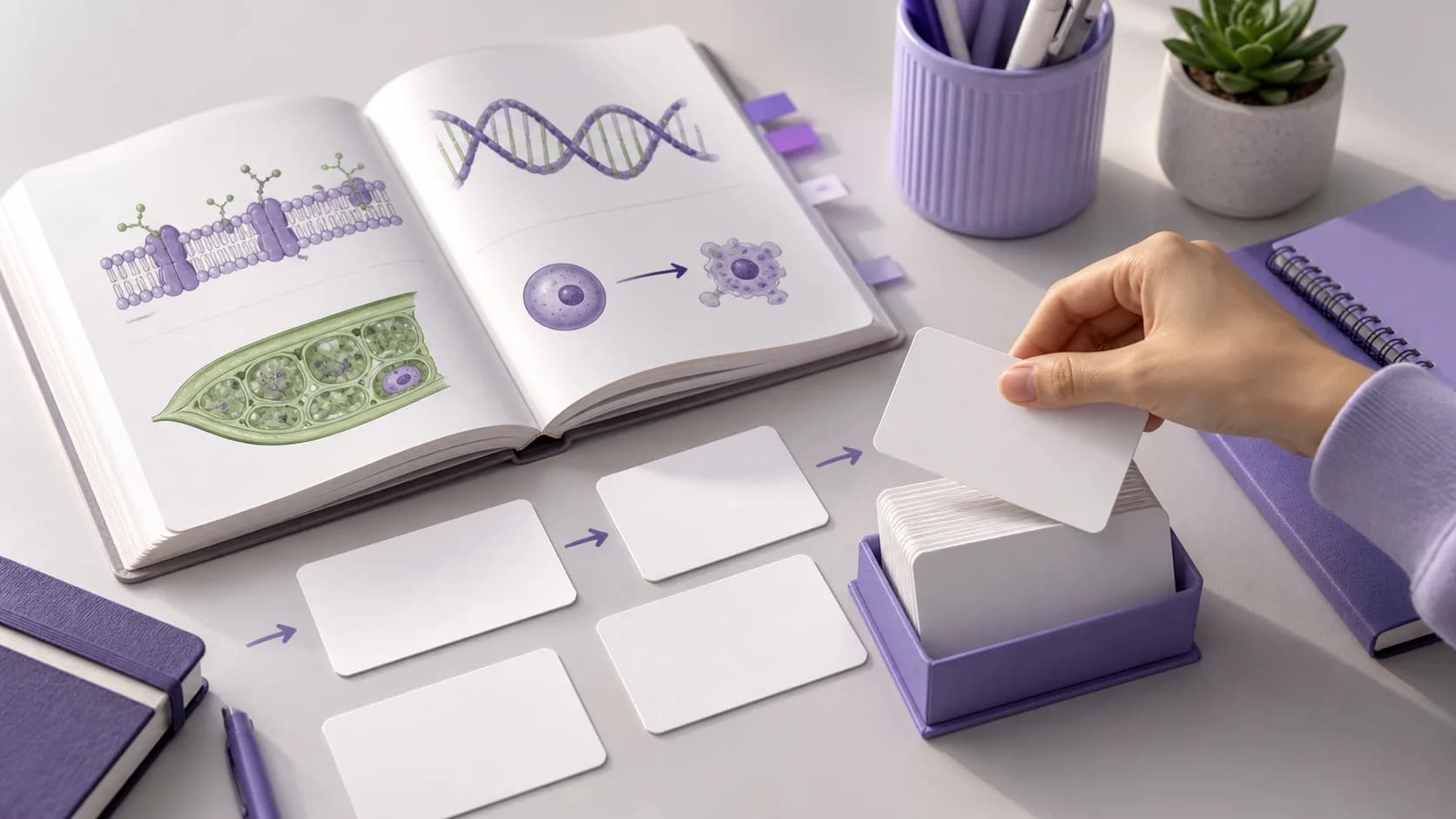
Good biology flashcards ask you to retrieve a precise idea, relationship, structure, or process before you see the answer. Start with one checked source, divide the topic into small learning targets, and choose a card format that matches each target. Use direct questions for terms, blank diagrams for structures, ordered prompts for processes, and short scenarios for application. Then answer each card without your notes and check every mistake against the source.
The goal is not to copy a biology chapter onto cards. The goal is to build a focused set that shows whether you can explain and use the material.
What makes a biology flashcard useful?
A useful card creates one clear retrieval task. The front tells you exactly what to recall. The back gives the smallest complete answer and enough context to correct a mistake.
Biology needs more than definition cards. A course can test whether you can:
- identify a structure in a diagram;
- connect a structure to its function;
- explain a process in the correct order;
- compare two mechanisms;
- predict what happens when one condition changes;
- interpret a simple graph, table, or experiment;
- use evidence to support a biological explanation.
Your cards should match these tasks. A deck that only asks for bold terms can feel easy while leaving the assessed work untouched.
Research supports the learning method behind good flashcards. A major review rated practice testing and distributed practice as high-utility learning techniques across many conditions. The review also warns that highlighting and rereading alone have lower utility (Dunlosky et al., 2013). A separate experiment found that repeated retrieval supported delayed recall better than repeated study after initial learning in that task (Karpicke and Roediger, 2008).
Flashcards help when they make you retrieve. They become another reading task when you reveal the answer too early.
How to make biology flashcards step by step
1. Choose one source set and one small topic
Do not begin with the whole course. Choose one defined topic, such as membrane transport, DNA replication, or natural selection.
Gather the sources that your course expects you to use. These might include one lecture note, a textbook section, a laboratory guide, and a diagram. Keep each source available while you build and verify the deck.
If your lecture and reading explain the same concept differently, keep both notes intact. You can link related notes and follow their backlinks instead of copying everything into one long note.
Write the scope in one sentence. For example:
I need to identify transport types, explain their energy needs, and predict movement across a membrane.
This sentence stops the deck from expanding into every fact near the topic.
2. Make a checked topic outline
Create a short outline before you write cards. Use the syllabus, learning objectives, or assessment guide when available.
For membrane transport, the outline might contain:
- concentration gradients;
- simple diffusion;
- facilitated diffusion;
- osmosis;
- active transport;
- transport proteins;
- application examples.
Check the outline against the source. Add a missing concept now, not after you have studied an incomplete deck.
This step also separates source problems from card problems. If the note gives no clear explanation, repair the note before you generate questions.
3. Match each learning target to a card type
Use the card format that fits the knowledge.
Term and identification cards
Use these for vocabulary, molecules, organelles, and visible structures.
Front: What is a concentration gradient?
Back: A difference in the concentration of a substance between two regions.
For a diagram, remove the label or cover one structure. Ask for the name and one relevant function. Keep the original labelled diagram beside the source so you can verify the answer.
Structure and function cards
These cards connect a biological feature to its role.
Front: How does the phospholipid bilayer affect the movement of ions?
Back: Its hydrophobic interior restricts direct ion movement, so ions usually need membrane proteins to cross.
Process cards
Use process cards for sequences such as mitosis, transcription, or an immune response. Test one stage or relationship at a time.
Front: What directly happens after a substrate binds to an enzyme's active site?
Back: An enzyme-substrate complex forms, which positions the reactants for the reaction.
Also add one card that asks for the complete process from memory. Small cards support accuracy. A whole-process card checks whether the pieces form a usable explanation.
Comparison cards
Comparison cards are useful when two terms are easy to confuse.
Front: What is the key energy difference between facilitated diffusion and active transport?
Back: Facilitated diffusion moves substances down a concentration gradient without direct cellular energy. Active transport uses energy to move substances against a gradient.
Application cards
Application cards turn a known rule into a prediction.
Front: A transport protein moves sodium ions from a lower concentration to a higher concentration. What type of transport is involved, and why?
Back: Active transport is involved because the ions move against their concentration gradient and require energy.
These cards can reveal whether you understand the rule or only recognize its wording.
4. Write the prompt before the answer
Start with the question. A copied note often produces a vague front such as “osmosis.” A complete prompt gives your brain a clear task.
Prefer:
- What moves during osmosis?
- Across what type of membrane does osmosis occur?
- In which direction does water move relative to water concentration?
- What would happen to an animal cell in a strongly hypotonic solution?
Avoid prompts with several unrelated tasks. Split a card when one part can be correct while another part remains unclear.
Do not add unnecessary clues. A multiple-choice card may test recognition unless the alternatives require careful reasoning. Try the question without options first when your assessment needs free recall.
5. Keep the answer short but complete
A one-word answer can hide a weak explanation. A paragraph can hide the point you must remember.
Use this answer pattern:
- state the core answer;
- add one essential condition or qualification;
- add a source reference when the detail needs checking.
For example:
Front: Why does active transport require cellular energy?
Back: It moves a substance against its electrochemical gradient. The cell supplies energy through a transport mechanism such as an ATP-driven pump.
Check technical wording carefully. The OpenStax Biology 2e section on active transport distinguishes primary active transport from secondary active transport. That distinction matters if your course expects both mechanisms.
6. Add diagrams without turning them into decoration
Diagrams should create a task. Do not add an image only because biology is visual.
You can use a diagram in three ways:
- cover one label and identify the structure;
- point to one structure and explain its function;
- show an unlabelled process and reconstruct its stages.
Inspect every crop. Make sure arrows, legends, scale information, and relevant boundaries remain visible. A diagram with a missing arrowhead can change the meaning.
For complex pathways, use a blank copy as a separate recall task. Redraw the pathway, then compare it with the checked source. A sequence of tiny image cards may not test whether you understand the complete system.
7. Verify every card before studying it
Generated and manually written cards can both contain errors. Run a short verification pass.
For each card, ask:
- Does the source support the answer?
- Does the wording match the course level?
- Is there only one defensible answer?
- Does the prompt include enough context?
- Is the answer complete enough to correct a mistake?
- Does the diagram show the intended structure clearly?
Label uncertain cards and remove them from the active deck until you can check them. Repeating a wrong answer makes the error more familiar.
8. Study with a retrieve, check, repair loop
Read the front, hide the answer, and produce a response. Say it aloud, write it, draw it, or point to the structure on a blank diagram.
Then compare your response with the back and source. Record why you missed it:
- missing fact;
- confused pair;
- wrong sequence;
- weak explanation;
- diagram recognition problem;
- application problem.
Repair the card or the note. Do not only mark it wrong. A confused pair may need a comparison card. A process error may need a whole-sequence prompt. A vague answer may need a more exact question.
The detailed active recall guide explains how to turn card results into the next review session.
9. Space and mix the review
Return to the deck after a delay. Keep difficult cards in review, but do not study only the cards that feel comfortable.
Mix related card types once the basics are stable. For example, alternate membrane definitions, transport diagrams, comparisons, and application questions. This forces you to identify the needed rule before answering.
Keep the deck inside its course and topic context. A clear folder structure helps when several modules reuse terms with different levels of detail.
A worked biology flashcard set
Suppose the learning target is: “Explain how substances cross cell membranes.” A balanced first set might contain:
- Definition: What is simple diffusion?
- Structure and function: Why can oxygen cross the phospholipid bilayer more easily than sodium ions?
- Comparison: How do simple diffusion and facilitated diffusion differ?
- Process: How does the sodium-potassium pump use ATP?
- Diagram: Identify the channel protein and describe its role.
- Prediction: What happens to net movement when both sides reach equilibrium?
- Application: Which transport mechanism explains glucose uptake in the given cell example?
- Whole-topic explanation: Explain passive and active transport to a student who knows what a cell membrane is.
This set tests more than eight isolated facts. It tests identification, explanation, comparison, sequence, and transfer.
How to use AI for biology flashcards
AI can draft cards from checked notes, slides, textbook sections, or transcripts. Give it a narrow scope and the card types you need. Ask it to separate definitions, processes, diagrams, comparisons, and applications.
Do not use the generated deck as evidence that the content is correct. Check technical terms, direction words, units, exceptions, and diagram labels against your course source.
Generate a small first set. Study it once and revise weak prompts before creating more. A shorter checked deck is more useful than a large deck that repeats unclear or incorrect material.
Common biology flashcard mistakes
Copying every sentence
Copied cards test whether you recognize a sentence. Turn the sentence into a specific question and write the answer in the smallest complete form.
Making only definition cards
Definitions matter, but biology assessments often require explanation, comparison, prediction, and data interpretation. Include those card types.
Splitting a process into unrelated fragments
Small cards can improve precision. Add a whole-process prompt so you also practise order and causal relationships.
Trusting an attractive diagram
Check labels, arrows, scale, and orientation. Use the course source as the reference.
Studying without repairing the deck
A repeated mistake contains useful information. Change the prompt, add context, or return to the source before the next session.
Final biology flashcard checklist
Before you study, confirm that:
- the deck covers one defined topic;
- every answer matches a checked source;
- each card creates one clear retrieval task;
- the set includes more than definitions;
- process cards test both stages and the complete sequence;
- diagrams remain readable and accurate;
- application cards use rules from the source;
- mistakes lead to a card or note repair;
- review happens after a delay.
If you want a first draft from your own checked course material, use BrainDen's biology flashcard generator. Verify the cards against your lecture, textbook, or laboratory source before you study them.
See BrainDen more often in Google
Choose BrainDen as a preferred source for your Google Top Stories.
Turn your next source into a study system.
Create structured notes, flashcards, quizzes, mind maps, and active-recall practice from your own material.